
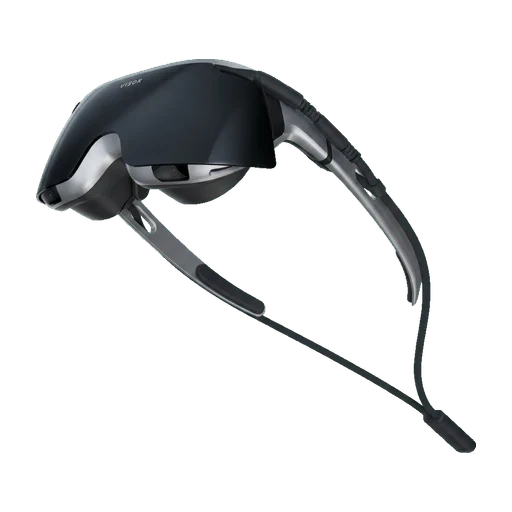
Immersed Visor — specification and verdict
Visor is built for one job: replacing the monitors on a desk with two micro-OLED panels behind pancake lenses, driven by a Windows, Mac or Linux computer over USB-C or streamed wirelessly. Immersed quotes 4K per eye and about 100 degrees of field of view, with eye tracking, hand tracking and colour passthrough, and no controllers in the box. IPD is not adjustable: the facial interface and lens spacing are made for the individual buyer's face, so one Visor fits one person. For VR training that is the wrong shape of device on paper, and there is nothing to test in practice, because no production unit has reached an independent reviewer.
There is nothing to deploy. Visor takes no Android package, has no vendor MDM and no kiosk mode, and every session needs a host PC plus the external battery and compute pack that also carries the wireless link. The custom-fitted facial interface rules out a shared headset, which is exactly the one-headset-many-trainees pattern most training rooms are built on. The 999 USD list price for the Visor 4K is not the whole spend either: Immersed sells its Visor Plus software tier as a separate monthly subscription, and the Founder's Edition sits at 1,499 USD. No distribution, service or warranty path for Poland or Germany has been published.
Do not order it for training. It is a personal productivity display, our courses are standalone Android VR applications that cannot run on it at all, and after nearly three years of pre-orders the delivery risk is the more serious problem. If you want a light micro-OLED headset, buy something that already exists and look at Visor again when units are in reviewers' hands.
How it compares within its class
The axis runs from the lowest to the highest published figure among the VR — PC-tethered devices in this catalogue. The grey tick is the median of that class.
Median for this class: 110°, from 39 models that publish the figure.
Median for this class: $899, from 45 models that publish the figure.
Controllers and hand tracking
No controllers — hands only
Bare hands
Gaze and pinch
Looking at something aims, a pinch selects. Enough to drive a menu, not enough to put a hand on a valve.
Full specification
An em dash means the manufacturer does not publish that figure.
- ManufacturerWho makes it — and who you buy support from.
- Immersed
- CategoryWhich kind of product this is. It decides which rows below make sense at all.
- VR — PC-tethered
- Device typeWhere the computing happens, and therefore what you need to run it.
- PC-powered VR
- AnnouncedThe day it was shown, which is not the day it shipped.
- 2023-08-03
- ReleasedYear the model went on sale. Older is not automatically worse in this category.
- Released: not published by the manufacturer
- AvailabilityWhether you can still order it new today.
- Announced
- Support endsThe date the manufacturer stops supporting it. Decisive for a fleet you are about to buy.
- Support ends: not published by the manufacturer
- PanelThe screen type. micro-OLED gives deeper blacks and higher contrast; LCD is brighter and cheaper.
- micro-OLED
- OpticsThe lenses in front of the panel. Pancake stays sharp closer to the edges than older Fresnel, which decides how much a trainee has to aim their head to read something.
- Pancake lenses
- Eyes coveredOne eye or both. Over a full shift this is a real difference in fatigue.
- Both eyes
- Resolution per eyePixels delivered to each eye. Higher means small text and labels stay readable.
- Resolution per eye: not published by the manufacturer
- Refresh rateImages per second. Higher feels smoother and helps people prone to motion discomfort.
- Refresh rate: not published by the manufacturer
- Field of viewHow much of your view the image covers. Bigger is more immersive, not automatically better for work.
- 100°
- Pixel densityPixels per degree of view — the honest way to compare sharpness between a headset and a pair of glasses. Higher is sharper. Only shown where somebody published it; we never compute it ourselves.
- Pixel density: not published by the manufacturer
- BrightnessIn a plant or outdoors, brightness decides legibility more than resolution does.
- Brightness: not published by the manufacturer
- WeightThe device alone. Anything above roughly 150 g is felt within an hour.
- ≈186 g*Engadget hands-on — the Immersed Visor aims for spatial computing's sweet spot
- Visible field of viewWhat the eye actually sees through the optics, by axis.
- Visible field of view: not published by the manufacturer
- Rendered field of viewWhat the device draws. Never smaller than what you see.
- Rendered field of view: not published by the manufacturer
- Binocular overlapWhere both eyes see the same thing — this is where depth happens.
- Binocular overlap: not published by the manufacturer
- Average pixel densityPixels per degree across the image. More is sharper.
- Average pixel density: not published by the manufacturer
- Peak pixel densityThe sharpest point, usually the centre of the lens.
- Peak pixel density: not published by the manufacturer
- Subpixel layoutHow the coloured dots sit in a pixel. A stripe looks cleaner on text than PenTile.
- Subpixel layout: not published by the manufacturer
- Foveated renderingWhether detail is dropped outside where you look, to save performance.
- Foveated rendering: not published by the manufacturer
- PassthroughWhat the front cameras give you: colour, grayscale, or nothing.
- Colour
- Passthrough camerasResolution, density and frame rate of that camera feed.
- Passthrough cameras: not published by the manufacturer
- IPD adjustmentMatching lens spacing to the eyes. Motorised is fastest when one headset passes between people.
- None
- IPD rangeHow far the lenses travel to match eye spacing. A narrow range excludes part of any group of adults, which matters when one headset is shared.
- IPD range: not published by the manufacturer
- Works with glassesWhether people who wear glasses can use it — fits over them, or takes prescription lens inserts.
- Yes
- Vision correctionHow somebody who wears glasses uses it, and in what dioptre range.
- Lens inserts available
- DimensionsWidth, height and depth of the device itself.
- Dimensions: not published by the manufacturer
- Weight with strapWith the strap it ships with — the weight you actually wear.
- Weight with strap: not published by the manufacturer
- Head strapSoft band or a rigid one. Decides how the weight sits over an hour.
- Glasses frame
- MaterialsShell and facial interface, in the vendor’s words.
- plastic · foam facial interface
- ColoursColours the manufacturer sells it in.
- Black · Silver · Blue
- Haptics in the headsetVibration in the headset itself, not in the controllers.
- No
- TrackingWhether content stays put in the room (6DoF), follows head rotation (3DoF) or is simply fixed.
- inside-out 6DoF
- Base stationsWhether boxes have to be mounted on the walls before it works.
- Not needed
- Tracking camerasHow many cameras it uses to know where it is.
- Tracking cameras: not published by the manufacturer
- Tracking rateHow often position is recalculated. Higher is steadier.
- Tracking rate: not published by the manufacturer
- Depth sensorA dedicated sensor for distance, on top of the cameras.
- Depth sensor: not published by the manufacturer
- Hand trackingWhether bare hands can operate the interface, without a controller or the phone.
- Yes
- Hand tracking detailHow much of the hand reaches the application: a pinch, or a jointed hand pose a scenario can read.
- Gaze and pinch
- Hands and controllers at onceWhether a controller in one hand and a bare hand in the other work at the same time.
- Hands and controllers at once: not published by the manufacturer
- Hand tracking SDKThe SDK an application reaches the hand tracking through, and any named modes that change how it behaves.
- Hand tracking SDK: not published by the manufacturer
- Eye trackingThe headset knows where the trainee is looking. Enables sharper rendering where they look, and attention analytics.
- Yes
- Face trackingTracks facial expression — for avatars, not for training scenarios.
- No
- Body trackingHow much of the body the device knows about. Estimated legs are not tracked legs.
- None
- Controllers includedWhether motion controllers come in the box, or are bought separately — or the device is hands-only.
- No
- Controller tracking6DoF controllers track position and rotation, so a hand reaches in space; 3DoF only point. “None” means hands only.
- None (hands only)
- Other controllersWhether the headset works with controllers other than the ones it ships with.
- Other controllers: not published by the manufacturer
- Other input methodsWays in beyond controllers and bare hands.
- Other input methods: not published by the manufacturer
- ProcessorThe processor and memory inside. This is what the performance grade above is derived from.
- ≈Qualcomm Snapdragon XR2+ Gen 2*VR.org — Immersed says Visor is nearly here again
- CPUCores and clocks, where the manufacturer publishes them.
- CPU: not published by the manufacturer
- GPUThe graphics part of the chip.
- GPU: not published by the manufacturer
- MemoryRAM on the device. Together with the chipset it sets how complex a scene can be.
- Memory: not published by the manufacturer
- StorageOn-board space for downloaded courses. More matters for an offline library in several languages.
- Storage: not published by the manufacturer
- SD card slotWhether storage can be added with a card.
- SD card slot: not published by the manufacturer
- BatteryRuntime as the manufacturer states it. A hot-swappable pack matters more than the figure.
- ≈180 min*Road to VR
- Battery capacity (Wh)Energy in the cell. Bigger is longer, given the same power draw.
- Battery capacity (Wh): not published by the manufacturer
- Battery capacity (mAh)The same fact in the other unit vendors use. We never convert between the two.
- Battery capacity (mAh): not published by the manufacturer
- Charge timeFrom empty to full. Rarely stated by the manufacturer, so it usually comes from whoever timed it.
- Charge time: not published by the manufacturer
- ChargerPower of the supplied charger — it decides the charge time above.
- Charger: not published by the manufacturer
- External batteryBattery on a cable or a puck instead of on the head.
- Yes
- Charging caseExtra runtime carried in the case the glasses ship with.
- Charging case: not published by the manufacturer
- Hot-swap batteryWhether a charged battery can replace the empty one without ending the session. This is what decides if a headset can hold an all-day training station.
- Hot-swap battery: not published by the manufacturer
- Runs Skillsive appsOur own statement about whether Skillsive training applications run on it today.
- No
- Suitable for trainingOur judgement on whether it survives real deployment: comfort, hygiene, fleet management.
- No
- Kiosk mode / MDMVendor tooling to enrol devices, push an app and lock the headset to it. Practically required above ten devices.
- No
- Business tierAn official business tier, so devices belong to the company rather than to employees’ personal accounts.
- No
- Swappable facial interfaceRemovable, wipeable face padding. A consumable, and the difference between shared use and complaints.
- Swappable facial interface: not published by the manufacturer
- CertificationsIndustrial certifications stated on the manufacturer's own page. Empty means unconfirmed, never "probably fine".
- Certifications: not published by the manufacturer
- PortsPhysical sockets and charging contacts.
- USB Type-C
- Wi-FiThe Wi-Fi generation — it decides how well wireless streaming holds up.
- Wi-Fi
- BluetoothFor controllers, headphones and accessories.
- Bluetooth: not published by the manufacturer
- Video from a computerWhether a computer can drive it, over a cable or wirelessly.
- Over a cable · Wireless
- AudioBuilt-in sound. Matters most where somebody has to hear a remote expert while working.
- Audio: not published by the manufacturer
- MicrophoneBuilt-in microphone — the other half of talking to a remote expert.
- No
- MicrophonesHow many. An array picks a voice out of a noisy hall; one does not.
- Microphones: not published by the manufacturer
- Price bandThe band it sits in, rather than a price that goes stale.
- Premium
- Launch priceThe manufacturer's launch price. Fixed history, so it never goes stale.
- $999
- Price by configurationWhat each configuration cost at launch.
- Visor 4K $999 · Founder's Edition $1499
- Price todayApproximate current net price in USD — a general figure, since these barely differ between regions once tax is stripped out. A snapshot from the date shown, not an offer.
- Price today: not published by the manufacturer
- Comfort (from reviews)How it wears over a full session. Scored from agreement between independent reviewers, not from our own testing.
- Comfort (from reviews): not published by the manufacturer
- Edge clarity (from reviews)Sharpness away from the centre of the lens. Scored from agreement between independent reviewers.
- Edge clarity (from reviews): not published by the manufacturer
- Tracking reliability (from reviews)How tracking holds up in poor light and fast movement. Scored from agreement between independent reviewers.
- Tracking reliability (from reviews): not published by the manufacturer
- Hand tracking quality (from reviews)How usable controller-free hand tracking is in a training scenario. Scored from agreement between reviewers.
- Hand tracking quality (from reviews): not published by the manufacturer
Who this device is for
The buyer here is a single developer or analyst who wants several large virtual screens in a small space and already runs Immersed on a desktop. It is not a device for a training team, a rental fleet or anyone who has to pass a headset between people, because the facial interface and the fixed IPD are cut for one face.
What is missing, and what the manufacturer does not publish
Immersed publishes marketing lines rather than a spec sheet: no pixel count behind the 4K-per-eye claim, no refresh rate, no brightness figure and no battery capacity, and the only weight in circulation — 186 g — comes from Engadget's hands-on, not from Immersed, whose own pages still say just 'lighter than a smartphone'. There is no IPD range because the headset is built with a fixed, per-buyer IPD, and the 100-degree field of view carries no axis, while VRcompare instead lists 102 degrees horizontal and 92 vertical. Immersed also changed its pre-order entry pricing in July 2026 citing a RAM and storage crunch, so the numbers a buyer sees depend on which page and which month, and with no ship date, no unit count and no production photography, every performance figure remains untested. The company's own most recent shipping update is dated October 2024 and still points at a January delivery window that has long passed, and no independent reviewer has confirmed receiving a retail unit.
Immersed Visor — frequently asked questions
- Has the Immersed Visor actually shipped yet?
- No. Pre-orders opened in September 2023 for a 2024 target, and as of August 2026 no production unit has reached an independent reviewer. Immersed said in July 2026 that it was locking in shipping timelines and would follow with a production update, with Founder's Edition units going out roughly six months before the standard Visor 4K. Treat any date you see as a plan, not a delivery.
- What does the Immersed Visor cost, and what is the Founder's Edition for?
- Immersed's own shop lists the Visor 4K at 999 USD and the Founder's Edition at 1,499 USD, the latter a limited run that adds a custom faceplate and priority shipping about six months ahead of the standard model. Neither price includes the host PC or the Visor Plus software subscription, which is billed monthly on top.
- Can several trainees share one Immersed Visor?
- No. The facial interface is made for the buyer's own face and the IPD is fixed rather than adjustable, so a second person gets the wrong lens spacing and a poor seal. For shared use in a training room you need a standalone headset with IPD adjustment and a swappable facial interface instead.
Compare this device
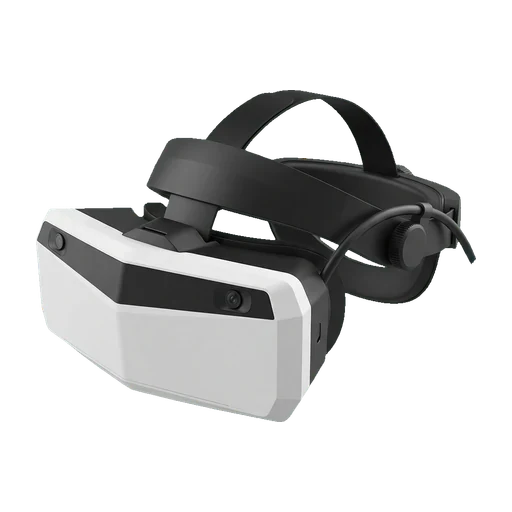
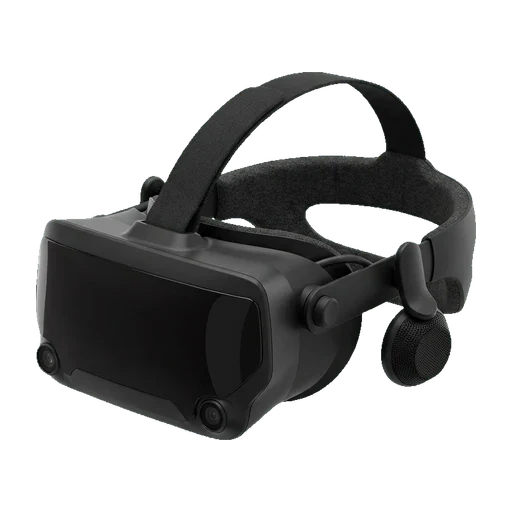
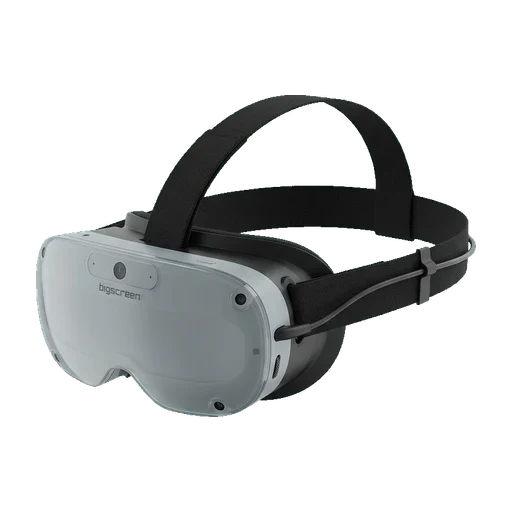
Consider these too
The nearest devices in the same class, ranked by availability and launch price — not by our opinion of them.
Specifications checked against the manufacturer's page on 2026-08-10. Manufacturer's specification
Product and company names used here are the trademarks of their respective owners and appear only to identify the hardware being compared. We are not affiliated with, sponsored by or endorsed by any of these manufacturers. Illustrations are our own.