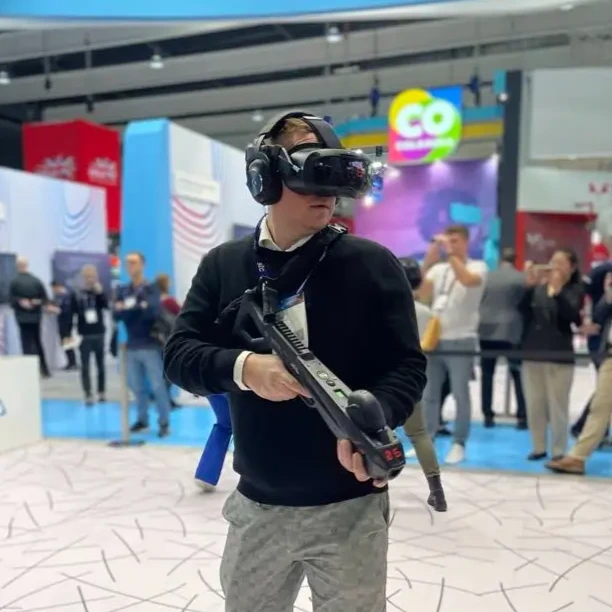
Multiplayer VR training puts two or more people in the same virtual scenario at once, practicing a task that in real life also involves more than one person. It earns its cost and setup time when the task being trained is inherently a team task — coordinating hand signals with a crane operator, running a two-person CPR response, handing off a shift safely — not when it's simply the same solo skill practiced in the same room as someone else.
That distinction matters more than the technology. A headset can put ten people in one virtual warehouse, but if the training task is "each person operates a forklift," running it as ten solo sessions is simpler and just as effective. Multiplayer earns its place when the coordination itself is the thing being trained.
What multiplayer VR training actually means
Multiplayer VR sessions come in three technical flavors, per Meta's own developer documentation: synchronous, where users act in the scenario together in real time; asynchronous, where trainees work toward a shared goal without being present at the same time; and collocated, where multiple headsets in the same physical room share a spatial anchor for a mixed-reality session (Meta, 2026). Sessions are organized around a lobby, where a group of trainees gathers, and a match, the specific scenario instance they enter together — the documentation doesn't publish a maximum number of participants per session, so the real ceiling is whatever the app was built to support.
This is a feature of immersive VR apps specifically — Meta's documentation notes multiplayer is currently supported only in immersive apps, not in flat 2D panel or standard Android applications running on the headset (Meta, 2026).
Does training with a group actually beat training alone?
For tasks that require coordinating with someone else, the strongest evidence available says yes, and by a wide margin. A randomized controlled trial split 40 participants into team-based and individual VR training groups, ran them through five VR training sessions over six weeks, then tested everyone on the same real-world task — performing an anterior hip arthroplasty on a high-fidelity surgical model. The team-trained group completed the assessment 33% faster (28.2 ± 5.5 minutes versus 41.8 ± 8.9 minutes) and made fewer than half the technical errors of the individually trained group (10.4 ± 6.1 versus 22.6 ± 5.4 errors, p < 0.001). Non-technical skill scores — the standardized ratings surgeons use for things like communication and situational awareness — were also significantly higher for the team-trained group across all three scales used in the study (Annals of Surgery, 2023).
That study is surgery, not workplace safety, and the two aren't interchangeable. But the underlying task shape is the same one that shows up in industrial and safety training: a procedure where success depends on more than one person acting in coordination, not on any single person's individual skill. It's the closest peer-reviewed comparison of team versus solo VR training currently available, and it points the same direction plain intuition does — a task that is a team task in reality trains better as a team task in VR.
The kind of task where group scenarios earn their keep
The clearest candidates for multiplayer VR training are tasks that are structurally impossible to do alone. A rigger and signalman team relies on one person operating equipment while reading hand or voice signals from a partner who can see what the operator can't — practicing that alone teaches half the skill at best, because the other half is reading and giving the signal in real time under the other person's pace. The same logic applies to a team CPR and AED response, where compressions, airway management and defibrillator operation are split across two or three people who have to hand off roles without breaking rhythm — a scenario one person can rehearse solo, but can't actually train the handoff itself without a partner in the scene.
Shift handovers, multi-person lockout/tagout procedures, and evacuation drills where a marshal coordinates several people through an exit route sit in the same category: the skill being tested is the coordination, and solo practice structurally can't test it.
What it takes to run a session
The baseline is one standalone headset per participant and a shared network — no cabling or dedicated PC required for most consumer and enterprise headsets on the market. Enterprise hardware adds features aimed specifically at this: the Pico 4 Ultra Enterprise lists Play Space Sharing for Location-Based VR among its Enterprise OS features, letting several headsets in the same physical room share tracking of that space rather than each mapping it independently (Pico Business, 2026). Whether that matters for a given training depends on whether the scenario is collocated (everyone physically in the same room) or networked (trainees in different locations joining the same virtual session) — the collocated case benefits most from shared spatial tracking, while a networked session mainly needs stable Wi-Fi per headset.
Battery life is worth planning for separately: multiplayer sessions tend to sit at the demanding end of what a headset can do, and battery runtime drops accordingly on longer group scenarios (details in VR headset battery life on a training day).
When solo is still the better choice
Most VR safety training isn't a team task, and forcing a group format onto an individual skill adds coordination overhead without adding training value. Using a fire extinguisher, recognizing a hazard on a production line, responding to a chemical spill as an individual first responder — these are all skills one person performs alone in reality, so training them alone in VR matches the real task exactly. Running the same headset through a queue of solo sessions is simpler to schedule, doesn't require every participant to be available at once, and doesn't add any of the technical dependencies multiplayer brings.
The decision rule is straightforward: if the real-world task has more than one person interacting with each other as part of doing it correctly, train it as a group. If it's one person's skill regardless of who else is nearby, train it solo.
Picking the right format
| Task shape | Format | Why |
|---|---|---|
| One person, one procedure (extinguisher use, hazard ID, spill response) | Solo | Matches the real task; simpler scheduling |
| Two-person coordination (rigger/signalman, team CPR) | Multiplayer, collocated | The coordination itself is what's being trained |
| Multi-site team drill (evacuation marshal + occupants) | Multiplayer, networked | Trainees can't realistically be in the same room |
| Shift handover, multi-step LOTO with a second verifier | Multiplayer, synchronous | Handoff timing is part of the skill |
Browse the full VR course catalog for scenarios built around individual skills versus ones built for a partner, and see how to run a VR training pilot with one headset for how to structure a first rollout before deciding whether a second headset earns its cost. The broader case for VR over classroom training either way is covered in why VR training is more effective than traditional training.